
he also talked about India's tradition of respecting the nature through festivals like 'Chhat' and referred to the ongoing cleanliness campaign.

The great Indian election is over and now the wait for the results is shrinking with every passing moment. Though exit polls hint at a cakewalk for Prime Minister Narendra Modi and his National Democratic Alliance, there are some battles which will be keenly observed on the result day.

'By resorting to divisive issues, the BJP is giving the impression that even if it is voted to power it won't do anything new to give Bihar a facelift. It will repel voters with the belief that the BJP can't do anything without communal polarisation as its core ideology. This is sad and unfortunate,' says Mohammad Sajjad.

'A fierce crusader against communalism, George joined hands with majoritarian forces, never to revisit or re-assess his saffron association.' 'He was a Union minister in 1998-2004, a time when people like Graham Staines were lynched in Orissa.' 'On the Gujarat pogrom of 2002, George went on to kind of justify the slashing of pregnant women, by saying in the Lok Sabha that this was nothing new for India.' 'Thus, he was in sharp contrast to what he had himself stood for in the heyday of his political career in the 1970s and 1980s, says Mohammad Sajjad.

highlights of what Bharatiya Janata Party's prime ministerial candidate, Narendra Modi and senior leader L K Advani said at the Statue of Unity launch event

'If enough of us take up the issue with their elected representatives, politicians will get the message.'

'A dangerous and false binary is now surfacing in Indian political discourse, which must be firmly rejected.' 'It is that we have to choose between freedom and development.' 'For us freedom is neither merely an instrument for development nor to be subordinated to development.' 'It is, as our founding fathers proclaimed early in our freedom struggle, 'our birthright' on which we shall never compromise.' 'Growth, wealth and development are fruits of democracy, not substitutes.' Dr Manmohan Singh's thoughts on democracy: A Must Read!

When most nonagenarians are content to pass their time in their neighbourhood's gardens, Raj Kumar Vaishya, 96, has enrolled himself in the Patna-based Nalanda Open University to pursue his lifelong dream of earning a masters in economics, reports MI Khan.

'It is a diamond which has a very long competitive history.'

'When it vanishes as a national force (meaning when it can no longer get sufficient votes to hold onto its symbol, the hand) it will not have been the first large Indian party to die,' says Aakar Patel.

'A second defeat in a Hindu heartland state will be disastrous for its morale and political fortune.' 'There is no alternative for the BJP, therefore, but to play the patriotic card with gusto.'

The Hindutva brigade's silence on the rape may possibly be explained that this incident is an intra-Hindu affair for them. What is even more intriguing is that vocal gender activists have preferred to almost ignore the incident. Why? Is it because homosexual rape does not involve the woman either as victim or as aggressor, asks Mohammad Sajjad.

'Dulat's professional successors in the game would now find it that much harder to access/create meaningful sources/assets needed for effective functioning in a place like Kashmir. By blowing their cover the former top spy has undone whatever he might have been able to add to his organisation's resource kitty.'
'Kanhaiya Kumar and others of his ilk are now out on bail. But what about the NIT 'anti-nationals'?' asks Amulya Ganguli.

The soul of India resides in pluralism and tolerance. This plurality of our society has come through assimilation of ideas over centuries. Secularism and inclusion are a matter of faith for us. It is our composite culture which makes us into one nation.
The real danger in India is not majoritarianism but minorityism, a bane we have already experienced. Majoritarianism in the India context means plurality and tolerance. No one needs to fear, says Vivek Gumaste

Here are 15 things you should know about Bharat Ratna Atal Bihar Vajpayee.

'The purported jitters of the ministers under Modi, the intriguing part is that the stories churned out by the rumour mill have not so far been denied. For aught I know, they may not be true. Or, if true, all that Modi intended was to subject his ministers to a process of grooming to ensure that all of them adhere to a uniform code of propriety, discernment and credibility,' says the distinguished civil servant B S Raghavan.

Taking exception to Health Minister Harsh Vardhan not mentioning the death of healthcare workers due to Covid-19 in his statement in Parliament, the Indian Medical Association has published a list of 382 doctors who died due to the viral disease and demanded that they be treated as "martyrs".

'Is Ansari flagging a genuine concern? Is a rectification called for?' 'And finally: Do minorities matter?' asks Shekhar Gupta.

'One hopes the younger generation sees Savarkar him for what he was and does not view him through a distorted prism.' 'This is the least one could do for someone who devoted his whole life to Indian freedom struggle, elimination of caste, succour to Dalits, and instilling of strategic culture in India,' says Lieutenant General Ashok Joshi (retd) and Colonel Anil A Athale (retd).

In the second and final part of his column, Col Anil Athale says the fight between forces of Indian nationalism and Macaulayism aided and abetted by West is going to be long, hard and dirty. The outcome will decide whether India becomes a superpower or continues to wallow in the swamp of underdevelopment.

'Does the Indian army's new assertiveness risk a clash escalating into shooting and possibly skirmishes?' asks Ajai Shukla.

Since many of Modi's urban policies were initiated in Ahmedabad, the city may act as a template to examine what can be expected in a country that is witnessing the biggest migration from rural to urban areas in the world
'If they were really serious (about conferring the Bharat Ratna on Savarkar) what were they doing for the last five years?' 'Why do they have to take so long?' 'Gandhi himself never got the Bharat Ratna so it does not really matter.'

'Today the Chinese think they can slap India, and there will be no consequences.' 'They must be made to feel the consequences through any and all means,' says Rajeev Srinivasan.

The challenges authorities face in cleaning Ganga and other holy rivers in Varanasi.

'We have not seen even during Vajpayee's time what Modi and the BJP has adopted now.'
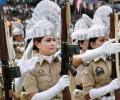
Glimpses of I-Day celebrations across India.
'And Indians are loving it,' says Shekhar Gupta.

'Tagore repeatedly denounced the "My country, right or wrong" attitude.' 'We often use the phrase "unity in diversity" like a cliche and often make diversity secondary, giving precedence to unity.' 'You do not have to shout from the rooftops that we are very tolerant.'

It is unconscionable to choose between Sardar Patel, who united India physically, and Indira Gandhi, who gave meaning, content and pride to the unity of the nation and became a martyr at the altar of national unity, says Ambassador T P Sreenivasan.
The West has always preferred a timid, half intelligent and a dependent India rather than a decisively independent and self-reliant one. A pliable Indian leadership suits the West best, says Tarun Vijay.

While the row over allowing women into the AMU library has been wrongly portrayed, it does not mean gender biases are non-existent in AMU. The campus does have its own shares of all kinds of cultural and ideological prejudices prevalent in the world outside. The AMU campus is not a segregated island, says Mohammad Sajjad.

Mark Tully on the India he loves.

The Tata empire turns 150 this year. R Gopalakrishnan, former director, Tata Sons Ltd, imagines a conversation among the group's founder Jamsetji, his son Dorabji, his successor, Nowroji Saklatwala, and his successor, J R D Tata.
Why are the 'secular' parties silent about the lynchings on our streets? Are they so busy forging political alliances that they ignore the numerous distortions of Constitutional values?

As two recently declassified Intelligence Bureau reveal that the Jawaharlal Nehru government had spied on the family of Subhas Chandra Bose for nearly two decades, one of India's political mysteries takes centrestage. Rediff.com reproduces this 2006 report in which Sumit Bhattacharya reported that a website claims that Netaji, in fact, did not die in an air crash, as was being believed, and that Netaji had escaped to Russia.

The more mud his opponents fling, the stronger Arvind Kejriwal emerges.

Germany, as the locomotive of Europe, has much to teach India in manufacturing and process management, says Rajeev Srinivasan.
